
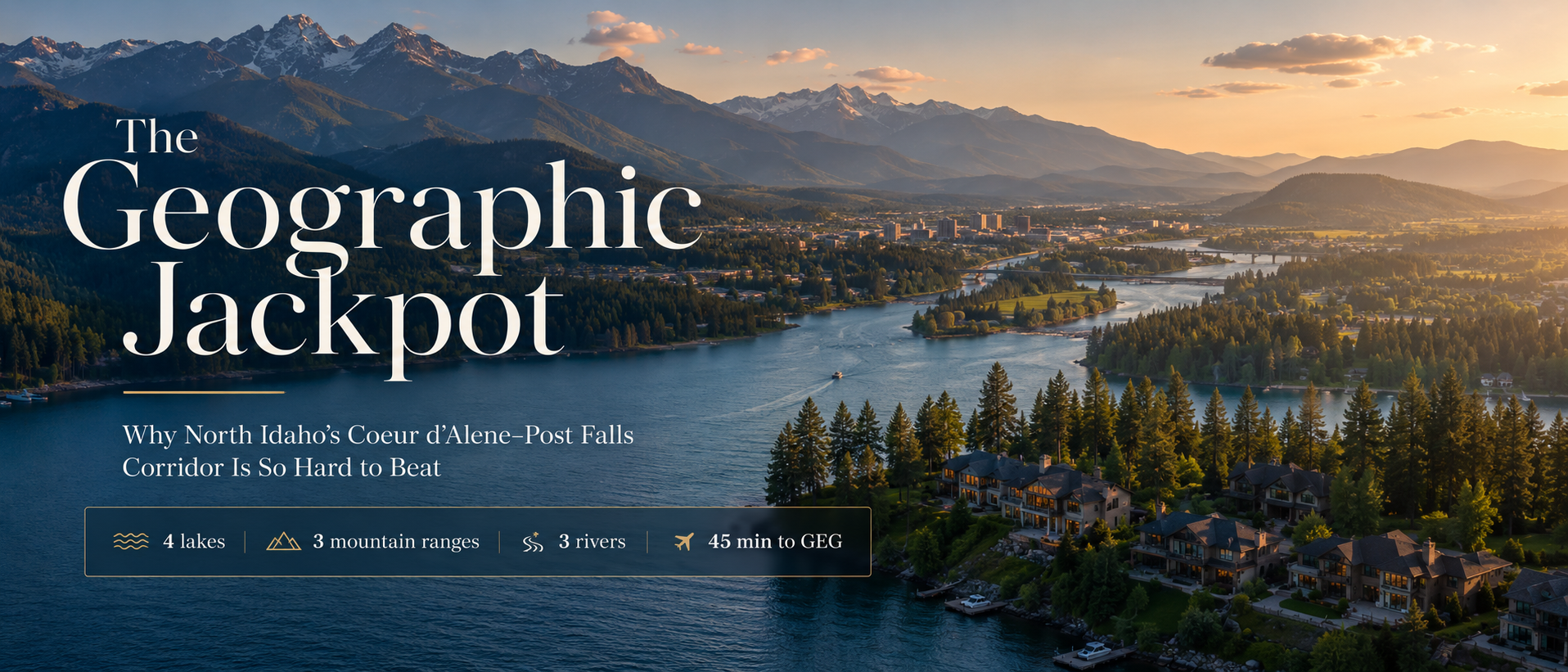
Most beautiful places have one thing going for them. A coastal town has the ocean. A mountain town has the peaks. A lake town has the water.
The Coeur d’Alene–Post Falls corridor has all of it. And once you actually look at a map and start measuring drive times, you realize it’s not a marketing line — it’s just geography.
That’s what I want to walk you through. Not the brochure version of North Idaho. The actual reason this little stretch of the panhandle keeps pulling people from California, Texas, Washington, and increasingly from places nobody would have guessed five years ago.
If you’re still building the bigger picture of the move, the complete North Idaho relocation guide for out-of-state buyers is the starting point — this article focuses on the geography behind it.
The Convergence Zone
Look at a map of the Inland Northwest and find the spot where the Rathdrum Prairie hits the foothills of the Coeur d’Alene Mountains. That’s where this corridor sits.
To the east: the Bitterroots, the Coeur d’Alene River drainage, and a lot of national forest. To the north: the Selkirks and a string of glacial lakes. To the west: the Rathdrum Prairie spilling toward the Washington state line and Spokane. To the south: the Palouse and the St. Joe River country.
Four very different landscapes — mountains, prairies, lakes, river valleys — meet within roughly an hour’s drive of downtown Coeur d’Alene. I’ve lived in places with one of these features. Having all four in arm’s reach is a different experience entirely.
What the Geography Gives You
Mountain Access
You don’t have to drive far to find serious mountains here. Three ranges are within easy reach:
- The Coeur d’Alene Mountains sit directly east, threaded with Forest Service roads, hiking trails, and the I-90 corridor that leads to Silver Mountain Resort in Kellogg.
- The Selkirk Mountains run north toward Sandpoint and the Canadian border. This is where Schweitzer Mountain Resort lives — 2,900 skiable acres, a 2,400-foot vertical drop, and an average of 300 inches of snow a year, according to Schweitzer’s official stats page.
- The Bitterroots form the Idaho–Montana border. Tucked into them is the Route of the Hiawatha, a 15-mile rail-trail through ten tunnels and seven trestles, including the 1.66-mile St. Paul Pass Tunnel.
Silver Mountain itself is a quieter alternative to the destination resorts — 1,600+ acres, a 2,200-foot vertical drop, and average annual snowfall in the 235–240 inch range, per OnTheSnow’s Silver Mountain stats. The resort runs day operations only (lifts close around 4 PM), but the gondola ride out of downtown Kellogg is one of the more unusual ski experiences in the country.
Lake Country
This is the part of North Idaho that does the heavy lifting in most relocation conversations. Four major lakes shape this region — three of them within an hour of downtown Coeur d’Alene, plus Priest Lake just beyond as a longer day trip:
- Coeur d’Alene Lake — 25 miles long, with over 109 miles of shoreline, according to U.S. Geological Survey and lake authority data. It’s often called one of the most beautiful lakes in the world, and the downtown waterfront, the boardwalk, and the cruises are what define the region’s identity.
- Hayden Lake — just 15 minutes north of downtown. About 7 miles long, with an irregular shoreline of roughly 40 miles and a maximum depth near 178 feet, per the Idaho Washington Aquifer Collaborative. (You’ll hear locals swear it runs 800 feet deep — that’s a long-running legend, not the surveyed number.) Quieter, residential, and home to some of the most coveted waterfront real estate in the region.
- Lake Pend Oreille — Idaho’s largest, 43 miles long with 111 miles of shoreline, and 1,158 feet deep at its deepest point. It is the fifth-deepest lake in the United States, according to Visit North Idaho. Sandpoint sits on its northern shore.
- Priest Lake — the one locals call the Crown Jewel of Idaho. A 19-mile glacial lake surrounded by old-growth cedar and remote enough that cell service is still a coin flip. The Priest Lake Chamber of Commerce is the starting point if you’ve never been.
Living within reach of four lakes like these is not normal. It’s the kind of thing you stop noticing after a couple of years, until a visiting friend points out that you have a beach problem most cities would kill for.
River Valleys
The rivers here aren’t scenic backdrops. They’re working recreation corridors:
- The Spokane River runs west out of Coeur d’Alene Lake straight through Post Falls. There’s a paddle launch ten minutes from my office. Falls Park in Post Falls is the kind of place you take out-of-town family and then come back the next weekend on your own.
- The Coeur d’Alene River is the wilder cousin. Floating, fishing, kayaking, and the chain lakes along its lower stretch are a regional secret the locals don’t really hide.
- The St. Joe River — known in Forest Service literature as the “Shadowy St. Joe” — is a federally designated Wild and Scenic River, with 66.3 miles protected, per Rivers.gov. Fly fishermen know it. Most everyone else hasn’t found it yet.
That’s three significant rivers, three different personalities, all reachable inside an hour.
The Spokane Factor
This is the piece that surprises buyers from out of state more than any other.
You can live on a quiet street in Post Falls or Hayden, in a town where everybody waves at the four-way stop, and be at a major-airport check-in counter in about 45 minutes. The drive from Coeur d’Alene to Spokane International Airport (GEG) is roughly 40 miles, mostly I-90, and runs about 45 minutes in normal traffic per Rome2Rio’s drive data.
From GEG, nonstop service reaches more than 20 destinations, including Seattle, Portland, San Francisco, San Diego, Los Angeles, Las Vegas, Phoenix, Salt Lake City, Denver, Minneapolis, Dallas, Atlanta, and Chicago Midway, per the official Spokane Airports nonstop flight list. That is a major airport. Not a regional strip with two flights a day to a single hub. The real thing.
Spokane gives you the rest of the metro support system too:
- Major healthcare. Providence Sacred Heart Medical Center is the regional referral hospital — high-acuity trauma, cardiac, neuro, and pediatric care all on one campus. MultiCare Deaconess covers the other side of town.
- Regional retail, services, and culture. Gonzaga basketball, the Spokane Symphony, the First Interstate Center for the Arts, and a food scene that has finally arrived. Costco, Trader Joe’s, the works.
- The combined Spokane–Coeur d’Alene corridor. The Census Bureau’s Spokane–Spokane Valley–Coeur d’Alene Combined Statistical Area population was 793,285 as of 2024. That’s the economic engine you’re plugging into without actually living inside it.
The Climate and Four-Season Lifestyle
North Idaho gets actual seasons. Not the Pacific Northwest version where it rains for ten months and you get tomatoes in August. The full four.
Summers in the Coeur d’Alene area run in the high 70s to mid 80s, with low humidity and long evenings on the lake. Winters are cold but workable in town, with most of the heavy snow falling at elevation. Spring and fall are short, beautiful, and the part of the year locals quietly love most.
The corridor benefits from a partial rain shadow east of the Cascades — wetter than central Idaho, drier than Seattle. The mountains catch the precipitation, the prairie stays sunnier than people expect, and that combination is what lets Schweitzer pile up 300 inches of snow a season while your driveway in Hayden sees a small fraction of that.
If you want a deeper read on the microclimates between Rathdrum, Coeur d’Alene, and Sandpoint — including why one town can get half the snow of another twenty minutes up the road — I wrote about it here.
What This Means for Real Estate
Geography doesn’t just sell scenery. It creates distinct buyer pathways. Here’s how it actually plays out in the market:
- Lakefront and lake-access. Coeur d’Alene Lake, Hayden Lake, and Lake Pend Oreille each have their own price ceiling, their own communities, and their own waitlist. Lake-access (without direct frontage) is the sweet spot for buyers who want the lifestyle without the seven-figure waterfront.
- In-town Coeur d’Alene. Walkable, restaurant-dense, lakefront-adjacent. Premium per-square-foot pricing, smaller lots, character homes mixed with new builds. Deeper read: the Coeur d’Alene living guide.
- Post Falls. This is where buyers go when they want Spokane access, newer construction, more square footage per dollar, and a genuine community feel. It’s the corridor’s value play. Deeper read: the Post Falls living guide.
- Hayden. Established residential neighborhoods, strong schools, lake proximity, and a quieter pace. A favorite of buyers who want to age in place. Deeper read: the Hayden living guide.
- Rathdrum. Newer growth, more space, often more land per dollar. The Rathdrum Prairie corridor is where families looking for room to breathe end up.
- Sandpoint and Lake Pend Oreille. A different lifestyle entirely — scenic, slower, ski-town-meets-lake-town. A longer commute to Spokane, but for many buyers that’s the point.
- Acreage and rural. Once you get a few miles off the main corridors, the lots open up. Five acres, ten acres, twenty acres — outdoor-oriented buyers and people running from HOAs both end up here.
The point is that the geography gives you options that don’t exist in most regions. You can buy a downtown condo, a lakefront home, a Hayden ranch, a Rathdrum new build, or a wooded acreage outside Athol — and all of them are the same drive to the same airport.
Which Buyers Benefit Most
A few buyer profiles consistently get the most out of this corridor:
Relocating families find school options across Coeur d’Alene, Post Falls, Lakeland, and Hayden that hold up, with open enrollment adding more flexibility than most newcomers expect. Pair that with affordable youth recreation and the value proposition is strong. (How the out-of-state buying process actually works.)
Retirees and 55+ buyers get the combination that’s hard to find anywhere else: major healthcare access in Spokane, a calmer pace in towns like Hayden and Post Falls, and four-season recreation that doesn’t require you to be 25. It’s why I added the Seniors Real Estate Specialist (SRES®) designation — this buyer pool keeps growing.
Outdoor recreation buyers see their travel time collapse. The drive from town to a trailhead, a boat ramp, or a chairlift is measured in minutes, not hours.
But the corridor’s real superpower is for the buyer weighing lifestyle against convenience. Most relocations force a trade — scenery for services, space for amenities, lifestyle for career. Here, you give up far less than you’d expect. That’s the part the map can’t show you.
The Bottom Line
Beautiful places exist all over the West. Good skiing exists. Good lakes exist. Good airports exist. What makes the Coeur d’Alene–Post Falls corridor unusual is that it has all of them, stacked inside an hour of each other, in a region where you can still actually buy a home.
That is the geographic jackpot. And every buyer I work with — whether they’re coming from Seattle, Phoenix, the Bay Area, or just across the state line from Spokane — has the same reaction when they finally see it on the ground. The map underrepresents it.
If you’re trying to decide whether North Idaho fits the life you want to build, I’d be glad to help you compare the towns, neighborhoods, tradeoffs, and homes that make the most sense for your move. No pressure, no pushy follow-ups — just an honest conversation about whether this corner of Idaho actually matches what you’re picturing.
Important disclaimers
I’m a licensed Idaho REALTOR®, not a tax advisor, attorney, or financial planner. This article presents geographic and market context based on publicly available data and my professional observations as an active North Idaho agent. It does not constitute advice on tax, legal, or financial matters.
Geographic and market data is current as of June 2026. Distances, drive times, snowfall, lake statistics, and airport service can change. Verify current conditions before making decisions.
Idaho real estate transactions are governed by Idaho law and the Idaho Real Estate Commission. As a licensed Idaho REALTOR® (License #SP-1371861) with Berkshire Hathaway HomeServices Jacklin Real Estate, I represent buyers and sellers within the scope of my licensure.
Frequently asked questions
How close is Coeur d'Alene to Spokane International Airport?
Coeur d'Alene is roughly 40 miles from Spokane International Airport (GEG), about a 45-minute drive via I-90 in normal traffic. Post Falls is even closer — typically 25 to 30 minutes.
What lakes are within an hour of Coeur d'Alene?
Within roughly a 60-minute radius you can reach Coeur d'Alene Lake (downtown), Hayden Lake (15 minutes north), and Lake Pend Oreille at Sandpoint (about 45 minutes). Priest Lake is a bit farther, about 90 minutes to the southern shore. Smaller alpine and chain lakes are scattered throughout the Coeur d'Alene and St. Joe River drainages.
How much snow does Schweitzer Mountain get?
Schweitzer averages around 300 inches of snowfall per year, with 2,900 skiable acres and a 2,400-foot vertical drop. Silver Mountain in Kellogg averages roughly 235–240 inches annually with 1,600+ acres of terrain.
What's the population of the Spokane–Coeur d'Alene corridor?
The Spokane–Spokane Valley–Coeur d'Alene Combined Statistical Area had a population of 793,285 as of 2024. The Coeur d'Alene metro alone exceeds 188,000, and U.S. Census Bureau population estimates have consistently ranked it among the faster-growing metropolitan areas in the western United States in recent years.
Is North Idaho a good place to retire?
For many buyers, yes — particularly those who want four-season recreation, smaller-town pace, and access to major Spokane healthcare. Shirin works extensively with 55+ buyers and holds the Seniors Real Estate Specialist (SRES®) designation through the National Association of REALTORS®. Healthcare access through Kootenai Health locally and Providence Sacred Heart in Spokane is one of the strongest factors retirees cite.
Let’s talk.
Whether you’re comparing towns from out of state or already have a budget and a timeline, I’d be glad to walk through how this corridor fits what you’re actually trying to build. Schedule a call with Shirin →
Shirin Abplanalp is a licensed Idaho REALTOR® (IREC License #SP-1371861) and SRES (Seniors Real Estate Specialist) with Berkshire Hathaway HomeServices Jacklin Real Estate, serving Coeur d’Alene, Post Falls, Hayden, Rathdrum, and Sandpoint. Brokerage office: 1927 W. Riverstone Drive, Coeur d’Alene, ID 83814 · (208) 758-7474.