
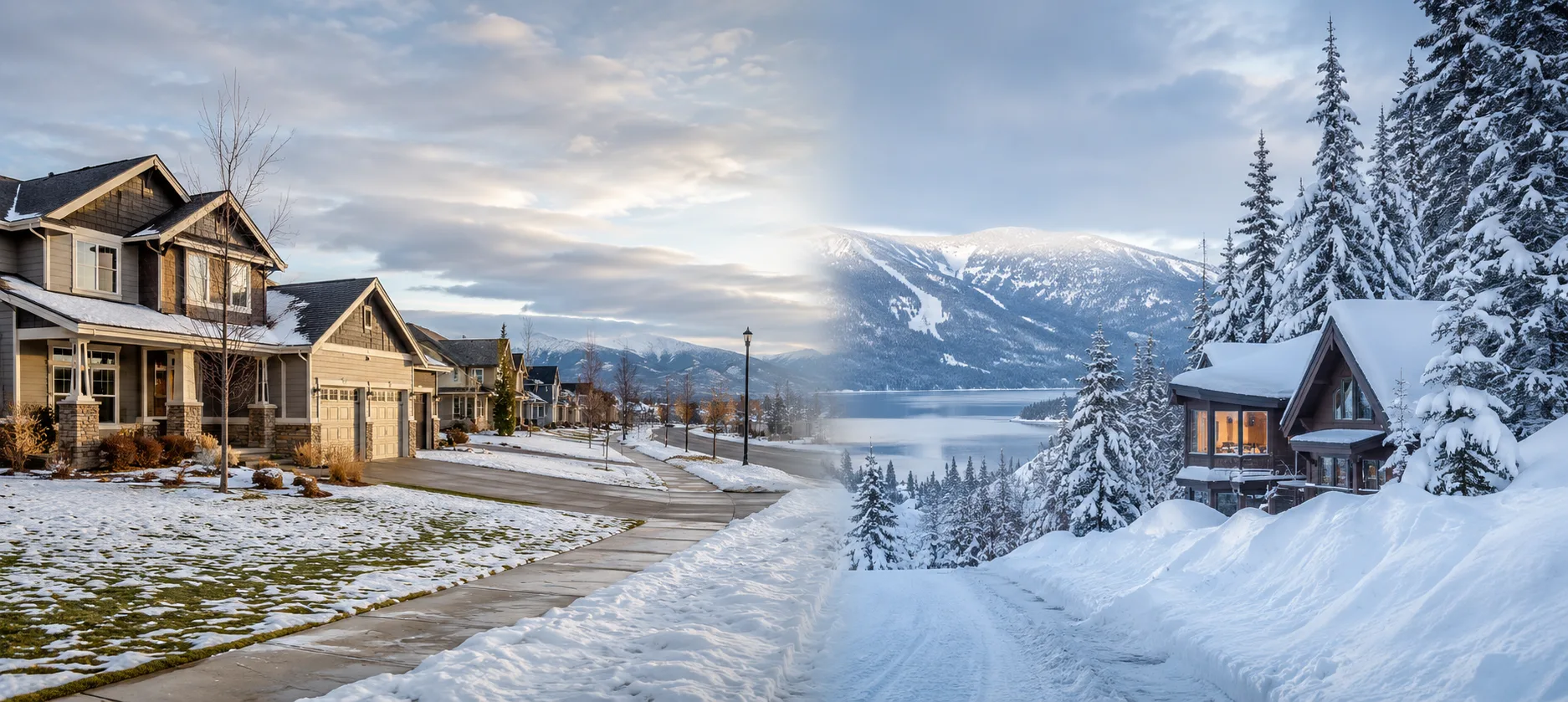
The Rathdrum Prairie — Post Falls, Rathdrum, Hayden, and the flatter parts of Coeur d'Alene — averages roughly 40–45 inches of snow per year, with most of it melting between storms. Drive 45 minutes north into Bonner County and Sandpoint, and you're suddenly in a different climate zone: 80 to 90 inches a year at lake level, snow that often stays on the ground from mid-December through early March, and a Schweitzer Mountain summit that pulls in roughly 300 inches annually.
Same state, same general region, completely different winters. As a Realtor who works both sides of this divide every week, the question isn't whether you'll see snow — it's whether the property you're considering needs a plow, a snowblower, or just a good shovel and a set of decent tires.
If micro-climate is driving your location decision, the full North Idaho relocation guide maps it to neighborhoods, commutes, and home prices.
The Two North Idahos: Why Rathdrum and Sandpoint Aren't the Same Winter
The Rathdrum Prairie sits in a wide, gravelly valley at roughly 2,200 feet, sheltered on the south by the Coeur d'Alene River drainage and on the north by a low band of foothills. That geography matters. Storm systems that roll east off the Pacific dump most of their moisture against the Cascades and the Idaho Panhandle's higher elevations before they reach the prairie floor. By the time they hit Post Falls, Rathdrum, and Hayden, they've usually shed enough water content that we get manageable, plowable snowfalls — typically 2 to 5 inches at a time, occasionally 8 to 10 in a heavier event.
Sandpoint is a different story. The town sits at the north end of Lake Pend Oreille, the deepest lake in Idaho at over 1,150 feet. That body of water acts like a heat reservoir in early winter and a moisture engine all season. Cold Canadian air masses sliding south across the lake pick up moisture and dump it on the north shore — a true lake-effect pattern that the National Weather Service Spokane Forecast Office tracks closely every season. Add the immediate rise of the Selkirk and Cabinet ranges directly behind town, and you have a textbook orographic snow zone. Bonner County's snow belt reputation isn't marketing — it's terrain physics.
Rathdrum Prairie: The Quiet Winter Most Buyers Don't Expect
For out-of-state buyers, the Rathdrum Prairie is usually the pleasant surprise. According to BestPlaces climate data sourced from NOAA station records, Rathdrum averages about 41 inches of snow per year and Post Falls averages roughly 40 inches. For comparison, the U.S. average is 28 inches — so yes, more than most places, but a far cry from Minneapolis or Buffalo.
Here's what that actually looks like on the ground:
Prairie Winter — Month by Month
In a typical winter on the prairie, snow stays on the ground in continuous coverage for roughly 30 to 60 days total— broken into stretches rather than one solid blanket. That's a critical distinction, because it changes what equipment you actually need.
Do you need a plow or tractor in Post Falls or Rathdrum?
For a standard subdivision lot with a two-car driveway, almost never. A good snow shovel and a $400–$800 single-stage electric or gas snowblower handle nearly every storm we get. The City of Coeur d'Alene's published snow plan says crews initiate plowing operations once accumulation reaches 4 to 5 inches on city streets — which gives you a sense of the scale we plan for. Most prairie storms come in under that threshold.
For longer rural driveways (a quarter mile or more), or properties on private roads off Highway 41 or out toward Twin Lakes, a compact tractor with a front blade or rear blower starts to make sense. But for the typical 0.2- to 0.5-acre lot inside city limits? No plow. No tractor. Just tires that respect the season.
Sandpoint and the Bonner County Snow Belt: A Real Winter
Sandpoint averages roughly 80 to 90 inches of snowfall per year at town elevation, and that number climbs fast as you gain elevation toward Schweitzer or push north toward the Canadian border. Ground cover in Sandpoint is typically continuous from mid-December through early March — often 70 to 90 consecutive days, sometimes longer.
The snow itself behaves differently too. Prairie snow tends to come in moderate doses and melt between storms. Sandpoint snow stacks. Roof loads matter. Berm management at the end of driveways matters. Whether your propane tank, septic risers, and oil fill are reachable in February matters.
What Sandpoint-area buyers actually need
If you're buying in Sandpoint, Sagle, Dover, Ponderay, or anywhere up Highway 95 toward Bonners Ferry, here's the honest gear list for a rural or semi-rural property:
Sandpoint Rural Property — Winter Gear List
Tractor with front-loader or plow
25–45 hp. $20,000–$35,000 new, $10,000–$18,000 used.
Two-stage snowblower
For areas the tractor can't reach.
Roof rake
Or a relationship with someone who clears roofs.
Heated water lines or freeze-protected well house
Essential at rural properties.
AWD or 4WD with dedicated winter tires
Not all-seasons. Sandpoint will teach you the difference fast.
For in-town Sandpoint lots inside the city plow zone, a snowblower and shovels can be enough — but you'll still want winter tires and probably AWD.
The Highway and Road Maintenance Reality
The other thing out-of-state buyers underestimate is how aggressively Idaho maintains its primary winter routes. The Idaho Transportation Department runs a fleet of more than 400 snowplows covering roughly 13,000 lane miles statewide, with District 1 handling the entire Panhandle including US-95, I-90, and the major state routes connecting Coeur d'Alene to Sandpoint and beyond. ITD's Idaho 511 system — accessible by dialing 511 or visiting the website — gives real-time road conditions, plow camera feeds, and closure alerts. I recommend bookmarking it before your first winter.
I-90 and US-95
Plowed and treated as quickly as any major interstate in the country. You can drive CDA to Sandpoint in a snowstorm if your vehicle and tires are appropriate.
County roads
Plowed but on a slower priority schedule.
Private and HOA-maintained roads
Entirely the responsibility of homeowners or the association. Verify this before you make an offer on any rural property.
When I show acreage north of Hayden or out past Athol, the first question I ask the listing agent isn't about the well or the septic. It's who plows this road in February?
Local Municipal Snow Removal: What Your Tax Dollars Actually Do
Rathdrum
Declares a snow emergency once accumulation hits 3 inches in a 24-hour period or when the National Weather Service issues a winter storm warning, per the city's published snow removal ordinance. Vehicles must be off the street during a declared emergency or face a $150 citation and possible tow.
Coeur d'Alene
Initiates plow operations at 4 to 5 inches of accumulation, or at 3 inches if more snow is forecast.
Post Falls and Hayden
Operate on similar thresholds with their own local nuances.
Sandpoint
Plows continuously through major events given the snowfall volume — there's no wait-and-see the way prairie cities sometimes operate.
In all cases, you the homeowner are responsible for your driveway, your sidewalk (in cities that require it), and any private road access. None of these cities clear your driveway approach — the berm the plow leaves at the end of your driveway is yours to deal with.
What This Means for Your Home Search Across North Idaho
Buyers who cross-shop the Rathdrum Prairie against Sandpoint are usually comparing two genuinely different lifestyles, not two slightly different versions of the same one. Sandpoint offers the lake, the mountain, the postcard town, and a winter that asks more of you. The prairie offers proximity to Spokane, easier winters, larger flat lots, and a faster commute to almost everything. Neither is better. They serve different priorities.
What I've learned working both markets — and living in this region myself — is that the buyers who end up happiest are the ones who picked the climate that matches how they actually want to live in February, not just how the property looks in a July listing photo. If you're someone who loves the idea of snow but doesn't want to run a tractor at 6 a.m. before work, the prairie is probably your fit. If you want the lake town, the powder, and you're willing to gear up for it, Sandpoint and Bonner County are spectacular — but they ask for commitment.
Why Working With a Local Agent Matters Here
There are a lot of great Realtors in North Idaho. What I bring to climate-sensitive buyers is a road-tested map of which neighborhoods drift, which private roads get reliably plowed, which subdivisions have HOA snow removal built into dues, and which properties have south-facing driveways that melt themselves versus north-facing slopes that don't see sun until April. That's the kind of granular, lived-in knowledge you only get from showing homes through five or six full winters, not from a relocation guide.
If you're planning a move to Kootenai or Bonner County and want a straight answer on what winter actually looks like at the specific address you're considering, reach out. I'll pull the historical snow data for that zip code, tell you who plows the road, and walk you through what equipment the current owners actually use. No pressure, no scripted relocation pitch — just the real picture.
Common Questions
How many days does snow stay on the ground in Post Falls or Rathdrum?
In a typical winter, the Rathdrum Prairie sees continuous snow cover for roughly 30 to 60 days total — but it's almost always broken into multiple stretches rather than one unbroken blanket. Snow usually arrives in mid-to-late December, comes and goes through January and February with thaws in between, and is mostly gone by mid-March. You can expect bare lawns several times each winter even during the core snow months. This is dramatically different from Sandpoint's pattern of 70-plus consecutive days of ground cover.
Do I need a snowplow or tractor if I buy a home in Coeur d'Alene or Hayden?
For a standard residential lot inside city limits, no. A good snow shovel and a single-stage snowblower in the $400 to $800 range handle nearly every storm. The City of Coeur d'Alene only initiates municipal plowing once accumulation reaches 4 to 5 inches, which gives you a sense of the typical storm size. You will need a snowblower or tractor with a plow attachment if you buy rural acreage with a long driveway, a property on a private road, or anywhere north of Athol where snowfall increases.
How much more snow does Sandpoint really get compared to Coeur d'Alene?
Roughly double — and sometimes more. Sandpoint averages 80 to 90 inches of snow per year at town elevation, compared to about 40 inches on the Rathdrum Prairie. The gap widens fast as you gain elevation: Schweitzer Mountain Resort, just 11 miles from downtown Sandpoint, averages around 300 inches annually. The difference is driven by lake-effect snow off Lake Pend Oreille and orographic lift against the Selkirk Range, both of which the National Weather Service Spokane Office tracks as predictable seasonal patterns.
Are the highways between Coeur d'Alene and Sandpoint safe to drive in winter?
Yes, in almost all conditions, if your vehicle and tires are appropriate. The Idaho Transportation Department maintains US-95 and I-90 as priority winter routes with a statewide fleet of more than 400 snowplows. The Idaho 511 system gives you real-time road conditions, plow camera feeds, and any closure information before you leave the driveway. The right preparation is dedicated winter tires (not all-seasons), AWD or 4WD, an emergency kit, and a habit of checking 511 before any winter trip north of Hayden.
Who plows my driveway and the road to my house?
You do, for the driveway — every city in the region. For roads, it depends entirely on whether the road is public (city, county, or state maintained) or private. Public roads are plowed on a priority schedule. Private roads — common in rural Kootenai and Bonner County — are the responsibility of the homeowners or HOA. This is one of the first questions I ask the listing agent on any rural property, because the answer can mean the difference between a $200 annual HOA snow fee and a $5,000 tractor purchase.
Is the Rathdrum Prairie really a different micro-climate from Sandpoint, or is that just marketing?
It's a genuine micro-climate difference, well documented by the National Weather Service Spokane Forecast Office, which covers both areas. The Rathdrum Prairie sits in a sheltered valley at about 2,200 feet, with storm systems generally weakened by the time they reach it. Sandpoint sits at the north end of Lake Pend Oreille with the Selkirk Range immediately behind it, creating both lake-effect and orographic snow patterns. The result is roughly double the annual snowfall and significantly longer ground cover in Sandpoint, despite being only 45 minutes north.
What kind of vehicle do I need for winters in North Idaho?
For the Rathdrum Prairie and Coeur d'Alene, a front-wheel-drive sedan with proper winter tires handles most of the season. AWD or 4WD is helpful but not essential if you're staying on plowed routes. For Sandpoint and anywhere with significant elevation or rural access, AWD or 4WD with dedicated winter tires is the practical minimum. The Idaho Transportation Department specifically warns against using cruise control on icy roads — a tip worth tattooing on the back of your hand if you're coming from a warmer climate.
When is the best time to look at homes if I want to see what winter actually looks like?
Late January through mid-February. That window shows you the real snow load on roofs, how the driveway drains during a thaw, whether the road actually gets plowed, and how much sun the lot gets during the shortest days of the year. I encourage out-of-state buyers to make at least one trip during that window before they make an offer on a rural property. A house that looks magical in July can be a very different experience in a 30-degree freezing rain in February, and you deserve to see both.