
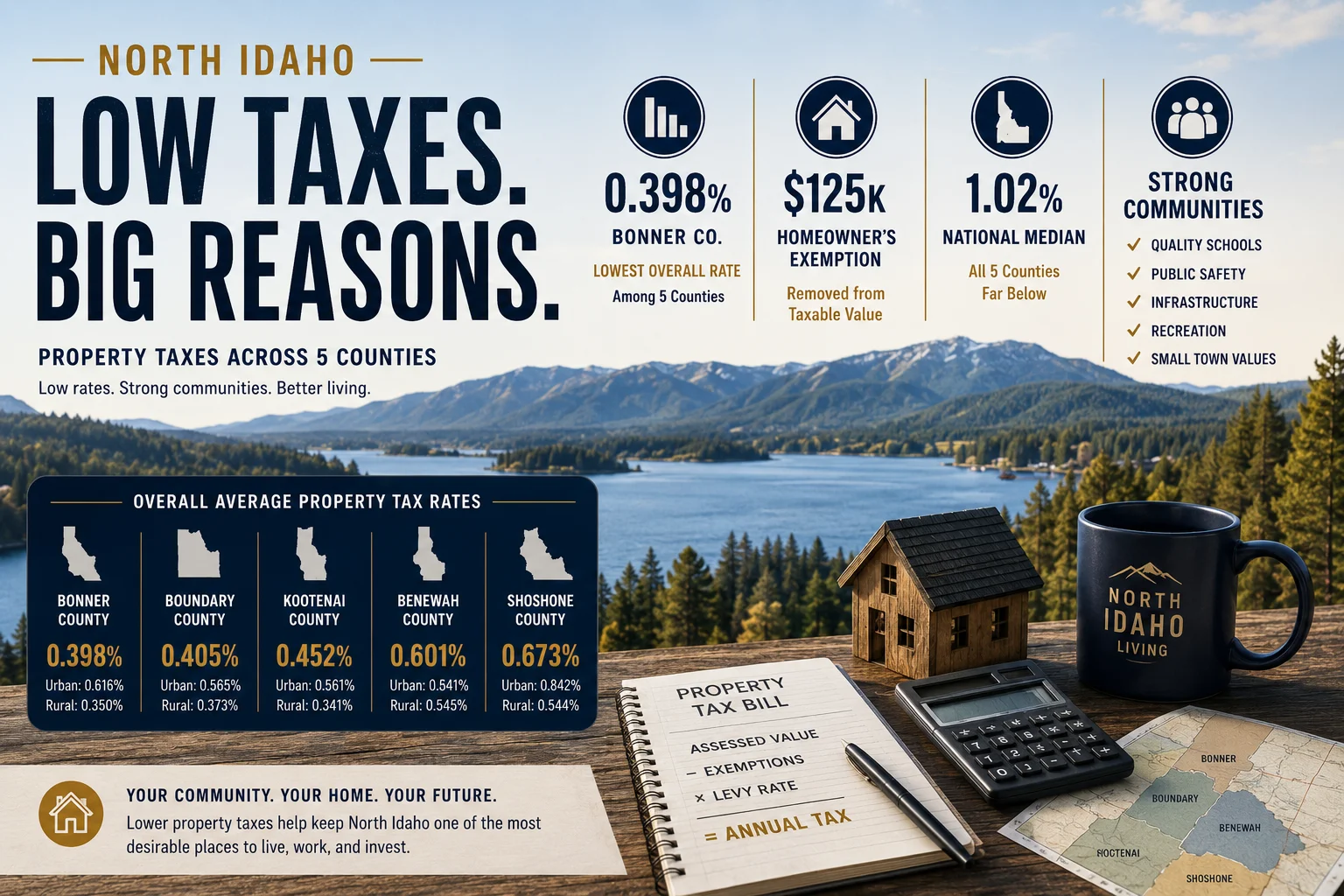
Property tax is one of the few hard numbers in a real estate decision that you can actually look up before closing — and one of the most consistently under-researched by out-of-state buyers. Comparing North Idaho's five panhandle counties shows meaningful differences: Bonner County's 0.398% overall rate and Shoshone County's 0.673% are separated by nearly 70%, and the urban-vs-rural gap within every county creates a second layer of variation that county averages alone don't capture.
The rates below come from the Idaho State Tax Commission's 2025 Average Property Tax Rates report (EPB00129), published November 25, 2025, based on actual levied amounts. These are official figures — not estimates or third-party data aggregations.
Property taxes are one part of the cost picture. For the full breakdown — income taxes, cost of living, home prices, and how North Idaho compares to California and Washington — see: Relocating to North Idaho: The Complete Local Guide for Out-of-State Buyers.
How Idaho property tax actually works
Idaho property tax is calculated at the county level but governed by state law (Idaho Code Title 63). Three numbers determine your bill:
Assessed value
The county assessor sets market value for every property as of January 1 each year. By law (Idaho Code 63‑205), assessed value must be 90–100% of fair market value. You receive a value notice in May and can appeal to the county Board of Equalization.
Taxable value
This is assessed value minus exemptions. For an owner-occupied primary residence, the homeowner's exemption removes the lesser of 50% of the home and one-acre value or $125,000 — the cap that has been in effect since 2021.
Levy rate
Each taxing district inside your county — school district, city, fire, library, ambulance, county itself, sometimes 30 or more districts overlapping — sets its own levy. Your total levy is the sum of every district that taxes your specific parcel. Kootenai County alone collects for approximately 45 taxing districts.
The formula is simple: (Assessed Value − Exemptions) × Levy Rate = Annual Tax. The complexity hides in the levy, because two homes on opposite sides of the same street can sit in different fire or school districts and pay meaningfully different bills.
The 2025 ranking — five counties, official rates
These are the 2025 average property tax rates published by the Idaho State Tax Commission. Urban rates apply inside incorporated city limits; rural rates apply in unincorporated areas; the overall average blends both. Bars below are scaled to the national median (1.02%) as the 100% benchmark.
Overall Average Rate — Scaled to National Median
Source: Idaho STC Report EPB00129 (2025)
On a $600,000 home with the homeowner's exemption applied, estimated annual property taxes by county:
Estimated Annual Tax — $600K Home, Homeowner's Exemption Applied
Before senior or veteran reductions. Estimates based on overall average rates; actual bills vary by taxing district.
Three observations worth noting: Bonner County's low overall rate, combined with the homeowner's exemption, produces some of the most tax-efficient lake-adjacent ownership in the Mountain West. Kootenai's broad tax base keeps the most populous county well below the statewide average — unusual for any county above 150,000 residents. And Shoshone and Benewah's higher rates aren't dysfunction — they're a structural reality of smaller populations funding fixed-cost public services.
County-by-county detail
Kootenai County
0.452% overallKootenai County covers Coeur d'Alene, Post Falls, Hayden, Rathdrum, and the surrounding Rathdrum Prairie — the largest population center in North Idaho at 180,000+ residents. That broad tax base is the single biggest reason the overall rate sits 31% below the statewide average. The county itself levies roughly $126 per $100,000 of value; the larger share of your bill comes from school, city, fire, and library levies layered on top. School districts 271 (Coeur d'Alene), 273 (Post Falls), and 272 (Lakeland) each carry their own voter-approved bond and supplemental levy — covered in the companion article on North Idaho school districts.
Bonner County
0.398% overallBonner County — Sandpoint, Priest River, Ponderay, Hope, Clark Fork, and the Priest Lake area — has the lowest overall rate in the five-county panhandle. Its 0.350% rural average is the lowest rural rate in North Idaho. Buyers should request the specific taxing district levy list from the county assessor for any parcel, because rates vary considerably between the City of Sandpoint and unincorporated rural zones. For buyers considering Bonner County's lake-adjacent market alongside the snowfall data, the snowiest cities ranking covers what the property tax savings come with in terms of winter management.
Boundary County
0.405% overallBoundary County, with Bonners Ferry as the county seat, sits just behind Bonner at 0.405%. Its small but stable tax base supports fewer overlapping districts than Kootenai. For buyers evaluating the northernmost panhandle — where remaining inventory below $400,000 is still real — Boundary's combination of low rates and rural land availability is a meaningful affordability story. The 0.373% rural average makes unincorporated acreage in Boundary County among the most tax-efficient in Idaho.
Benewah County
0.601% overallBenewah County — St. Maries, Plummer, Tensed — runs higher than its northern neighbors, with the 0.846% urban rate inside St. Maries the second-highest urban rate in the panhandle. The math reflects roughly 9,000 residents supporting school, road, fire, hospital, and ambulance districts that need a baseline level of funding regardless of how many taxpayers split the bill. Rural Benewah at 0.545% is closer to the statewide average and may be competitive for buyers focused on St. Joe River corridor acreage.
Shoshone County
0.673% overallShoshone County — Kellogg, Wallace, Pinehurst, Mullan, Smelterville — carries the highest overall rate in the panhandle, with the 0.842% urban average reflecting Silver Valley municipal levies for fire, EMS, and the hospital district. Rural Shoshone at 0.544% remains competitive with state averages. Buyers comparing in-town Kellogg or Wallace inventory against unincorporated parcels near Silver Mountain and Lookout Pass should specifically price in the urban-rural rate gap — on a $500,000 home it can be $1,000 or more per year.
The homeowner's exemption — apply the day you close
The homeowner's exemption is the single largest property tax break available to Idaho residents. From the Idaho State Tax Commission:
Homeowner's Exemption — Key Terms
Apply the moment you close. Re-confirm the exemption is on your annual tax bill — assessor offices occasionally drop it after a deed change, and catching the omission in December is too late to recover that year's savings.
The Circuit Breaker — Idaho's Property Tax Reduction program
Idaho's Property Tax Reduction program — colloquially the “Circuit Breaker” — reduces taxes for qualifying homeowners by $250 to $1,500 per year on a primary residence and up to one acre. Eligibility is income-tested and requires the applicant to meet at least one qualifying status:
Circuit Breaker — Who Qualifies
For senior buyers — a meaningful share of the North Idaho relocation market — this program plus the homeowner's exemption can drop an effective property tax bill by $2,500 or more annually on a typical $500,000 home. As a Seniors Real Estate Specialist® (SRES®), I walk every qualifying client through the Circuit Breaker math before they close, because the deadlines are tight and the program is not automatic.
The 100% Service-Connected Disabled Veterans benefit
Veterans rated 100% service-connected disabled by the U.S. Department of Veterans Affairs qualify for a separate property tax reduction of up to $1,500 annually — with no income limit. Application is through the county assessor and requires VA disability documentation. This benefit stacks with the homeowner's exemption, making it the most powerful combination of property tax relief available to Idaho homeowners.
What to verify before closing
Statewide averages are useful for ranking counties, but your specific parcel's tax bill depends on which taxing districts cover that exact lot. Before you finalize an offer:
Pull the current tax statement
Kootenai, Bonner, Boundary, Shoshone, and Benewah all publish parcel-level tax history online through their county treasurer portals.
Confirm the homeowner's exemption status
If the seller is a primary-residence owner, the exemption should be on the parcel. If they're a second-home or investment owner, you'll need to apply yourself after closing.
Request the taxing district list
Ask the assessor for the specific districts that levy on the parcel. Two homes 500 feet apart can sit in different fire or school zones — and pay meaningfully different bills.
Model the new assessed value
If you're paying significantly above the current assessment, expect the assessor to revalue at or near your purchase price the following year. Budget accordingly.
Check for pending levy elections
School bonds and supplemental levies appear on May and November ballots and can shift your rate by 10–20 basis points. Ask the assessor about any upcoming measures.
Sources and data verification
The data in this article comes from the following primary sources:
- Idaho STC — 2025 Average Property Tax Rates (EPB00129)
- Idaho STC — Property Tax Reduction (Circuit Breaker)
- Idaho STC — Property Homeowners Overview
- Kootenai County Assessor — Property Tax Rates
- Bonner County Government
- Boundary County Treasurer
- Shoshone County Treasurer
- Benewah County Treasurer
- Idaho Code Title 63 — Revenue and Taxation
Important disclaimer
This article is for informational and educational purposes only and does not constitute tax, legal, or financial advice. Tax rates change annually, taxing district boundaries change, and exemption rules can be modified by the Idaho Legislature. Levy rates published here reflect 2025 data and will be updated when 2026 numbers are released. Before making any purchase, exemption claim, or tax-planning decision based on this information, consult with a licensed Idaho CPA, a tax attorney, or your county assessor's office directly. Shirin Abplanalp is a licensed REALTOR® and SRES®, not a tax professional.
Frequently asked questions
Which North Idaho county has the lowest property tax rate?
Bonner County has the lowest overall property tax rate in the five-county panhandle at 0.398%, per the Idaho State Tax Commission's 2025 published averages. Boundary County is second at 0.405%, followed by Kootenai at 0.452%, Benewah at 0.601%, and Shoshone at 0.673%. All five panhandle counties except Shoshone run below the Idaho statewide average of 0.605%, and all five run well below the national median effective rate of approximately 1.02%.
What is the Idaho homeowner's exemption and how much does it save?
The Idaho homeowner's exemption removes the lesser of 50% of the home and one-acre value or $125,000 from the taxable value of an owner-occupied primary residence. This $125,000 cap has been in effect since 2021 per Idaho statute. On a $600,000 home in Kootenai County at the 0.452% average rate, the exemption saves approximately $565 per year. The exemption is one-time application through the county assessor and renews automatically as long as you continue to own and occupy the home.
How does the Idaho Property Tax Reduction Circuit Breaker work?
The Circuit Breaker reduces property taxes by $250 to $1,500 per year for qualifying Idaho homeowners. To qualify in 2026, total 2025 household income must be $39,130 or less after medical expense deductions, and the applicant must meet at least one qualifying status — age 65 or older, blind, widowed, disabled, former POW or hostage, or a motherless or fatherless child under 18. Applications run January 1 through April 15 each year through the county assessor's office, and the reduction appears on the December property tax bill.
Do veterans get a property tax break in Idaho?
Yes. Veterans rated 100% service-connected disabled by the U.S. Department of Veterans Affairs qualify for the Idaho Disabled Veterans Property Tax Reduction, worth up to $1,500 annually with no income limit. The reduction applies to a primary residence and up to one acre of land. Application is through the county assessor and requires current VA disability documentation. This benefit stacks with the standard homeowner's exemption.
How is my property's assessed value determined in Idaho?
Idaho county assessors are required by law (Idaho Code 63‑205) to assess property at 90 to 100 percent of fair market value as of January 1 each year. The assessor reviews recent comparable sales, building permits, and physical changes to the property. You receive a value notice in May, and if you disagree, you can meet with the assessor or file a formal appeal with the county Board of Equalization. If you purchase a home for significantly more than its current assessed value, expect the assessor to revalue the property at or near your purchase price the following year.
Why are Shoshone and Benewah County rates higher than Kootenai or Bonner?
Smaller populations spread a similar baseline of taxing-district costs across fewer taxpayers. Shoshone County, with roughly 13,000 residents, and Benewah County, with roughly 9,000, both support school districts, fire districts, EMS, hospital districts, and road levies that exist regardless of population. Kootenai County's much larger tax base (180,000+ residents) allows comparable services to be funded at a lower rate per parcel. This is a structural pattern across the rural Mountain West, not specific to North Idaho.
When are Idaho property taxes due?
Idaho property taxes are billed by the county treasurer in late November each year. Taxes can be paid in full by December 20, or in two installments — half by December 20 and the second half by June 20 of the following year. Late payments accrue interest at 1% per month plus a 2% late fee. Each of the five panhandle county treasurers — Kootenai, Bonner, Boundary, Shoshone, and Benewah — publishes payment portals and tax statement lookup tools online.
Should I rely on this article for my property tax planning?
No — this article is informational and reflects 2025 published data from the Idaho State Tax Commission and county assessor sources. Tax rates change annually, levy district boundaries can shift, and the Idaho Legislature periodically modifies exemption amounts and program rules. Before making purchase, exemption, or tax-planning decisions, consult a licensed Idaho CPA or tax attorney, and verify current rates and program details directly with your county assessor. Shirin Abplanalp is a licensed REALTOR® and Seniors Real Estate Specialist®, not a tax professional.