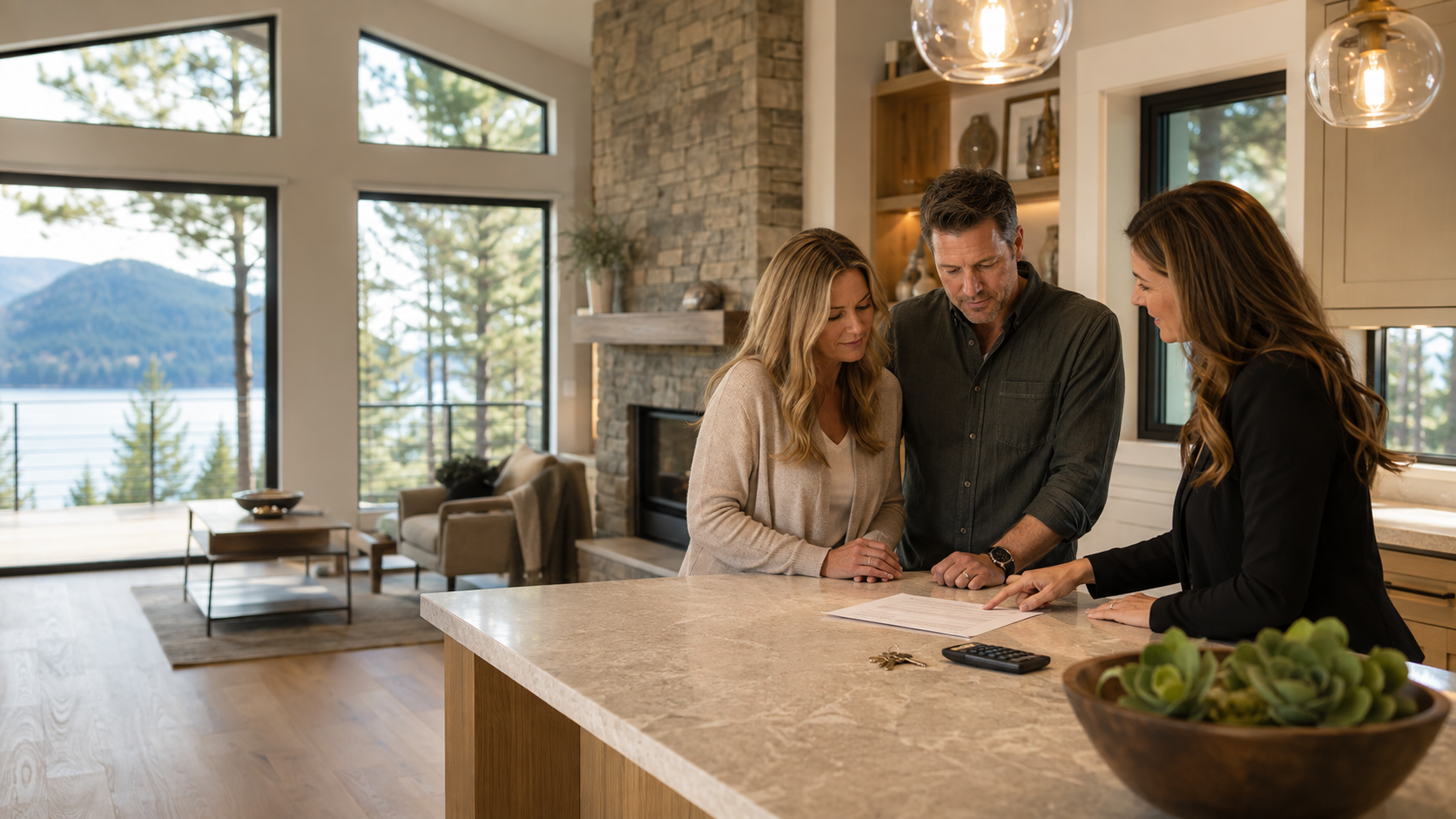
If you are thinking about buying a home in North Idaho right now, there is a good chance you are asking some version of the same question:
Should I buy now, or should I wait?
Wait for mortgage rates to come down.
Wait for prices to soften.
Wait for sellers to get more negotiable.
Wait for more homes to hit the market.
All of that sounds reasonable. The problem is that those things do not move independently.
If mortgage rates fall enough to make your payment noticeably better, you probably will not be the only buyer who notices. More buyers can mean more competition. More competition can mean less negotiating room. And the home that feels expensive today does not automatically become cheaper just because the interest rate does.
That is what makes the North Idaho market in 2026 interesting.
It is not the frenzy buyers faced a few years ago, but it is not a bargain basement either. There are more choices, more price reductions, more builder incentives, and more opportunities to negotiate — but those opportunities are not evenly distributed across every town, price range, or property type.
For a deeper look at the timing question alone, I also wrote Is It a Good Time to Buy a Home in Northern Idaho?. This guide goes broader: rates, affordability, new construction, resale, seller leverage, acreage, and where your money actually goes furthest.
So rather than trying to predict exactly what the market will do next, let’s look at the questions North Idaho buyers are actually asking in August 2026 — and what the numbers mean when you are the person writing the check.
First: North Idaho Is Not One Housing Market
One of the easiest mistakes to make is talking about “the North Idaho market” as though every buyer is shopping in the same pool.
They are not.
A buyer looking for a $475,000 home in Post Falls is participating in a very different market from someone shopping for five acres outside Sandpoint or a waterfront home on Lake Pend Oreille.
For site-built homes on less than two acres, the Kootenai County median sale price was $565,000 year to date through July 2026, up 3.8%, according to Coeur d’Alene Regional REALTORS®.
The same regional data showed 1,124 active residential listings as of August 5, 2026, while year-to-date sales were up 6.9%. The Kootenai County activity report gives buyers something they did not have much of during the hottest years of the market:
Choices.
And choices create leverage.
Realtor.com listing data hosted by FRED showed 348 price-reduced listings out of 961 active Kootenai County listings in July 2026 — roughly 36%. You can see the underlying active-listing data and price-reduction data directly.
That does not mean every seller is waiting to accept a huge discount.
It means overpriced homes are sitting long enough that sellers are having to respond.
A home that came on the market yesterday, shows beautifully, and is priced correctly may still give you very little negotiating room.
A home that has been sitting for 60 days after two price reductions?
That is a completely different conversation.
Bonner County is another market altogether
Bonner County is a perfect example of why one median can mislead a buyer.
Coeur d’Alene Regional REALTORS® reported a year-to-date median of $522,450 for site-built homes on less than two acres through July 2026. That report is here.
But Redfin’s Bonner County housing data has reported much higher medians when broader property types are included.
Those numbers are not necessarily contradictory. They are counting different houses.
Acreage, waterfront, and luxury homes around Sandpoint can move the median dramatically depending on the dataset. If you are shopping for a conventional home in town, a countywide number stuffed with waterfront acreage may tell you very little about the homes you are actually considering.
That is why I would rather look at your town, your price band, and your property type than hand you one North Idaho median and pretend it answers the question.
Should You Wait for Mortgage Rates to Drop?
This is probably the question buyers ask most often.
And here is the part that gets overlooked:
Waiting for lower rates is a bet on two things, not one.
You are betting that rates fall.
But you are also betting that home prices and buyer competition do not move against you when they do.
For the week ending August 13, 2026, Freddie Mac’s Primary Mortgage Market Survey put the average 30-year fixed mortgage rate at 6.67%.
Let’s turn that into real money.
On a $500,000 mortgage:
Interest rate / Approx. monthly principal & interest
A drop from 6.67% to 6.00% saves roughly $218 per month.
That matters.
But now look at the other side of the equation.
A 4% increase on a $565,000 home is $22,600. If lower rates bring more sidelined buyers back into the market, some of your payment savings can be eaten up by a higher purchase price — and you may find yourself competing for the same house instead of negotiating with one seller.
I am not predicting that is what will happen.
Nobody knows exactly where rates or home prices will be six months from now.
That is the point.
I would never recommend buying a house today because “you can always refinance later.” Today’s payment needs to work today.
But I also would not automatically postpone a purchase you can comfortably afford because you are hoping someone correctly predicts the mortgage market.
The better question is:
Does the home and payment make sense for you at today’s numbers?
How Much House Can You Actually Afford in North Idaho?
This is a much better question than: “How much will the bank lend me?”
Those are not the same thing.
Your mortgage is only part of the cost of owning a home. There are property taxes, homeowners insurance, possible HOA dues, utilities, maintenance, and — depending on the property — wells, septic systems, private roads, snow removal, and other costs that do not show up in the listing price.
Using the August 13 Freddie Mac rate of 6.67%, a 30-year loan, 20% down, an assumed $1,800 annual hazard-insurance premium, and Kootenai County tax assumptions based on Idaho State Tax Commission data, a rough planning range looks like this:
Approx. monthly housing budget* / Approx. home price with 20% down
*Principal, interest, estimated taxes and insurance. Not HOA dues, utilities, repairs, or maintenance. These are planning calculations, not loan quotes.
Idaho’s homeowner’s exemption can also affect the tax picture, and urban versus rural tax rates differ.
If you want the deeper county-by-county version, see my North Idaho property tax comparison.
But the most important question is not what a spreadsheet says you can technically buy.
It is: What payment still leaves enough room to live your life?
If buying the house means every repair, vacation, medical bill, or car problem becomes a financial emergency, the house is probably too expensive — even if a lender approves it.
Can You Still Buy a Home for Under $500,000 in North Idaho?
Yes.
But the compromises have changed.
Under $500,000 does not automatically mean leaving Coeur d’Alene.
As of August 19, 2026, Greenstone Homes at Coeur d’Alene Place was advertising several new cottage plans below $500,000, beginning around $444,000.
The tradeoff is size.
At that price, you are generally not getting a large rancher, a three-car garage, and a huge yard in central Coeur d’Alene.
Move toward Post Falls, Rathdrum, or surrounding communities and the equation changes again. If Post Falls is on your list, I break down the price bands in much more detail in How Much Do Homes Cost in Post Falls, Idaho?
This is where buyers need to stop thinking only in terms of price and start thinking about what they are willing to trade.
More square footage or shorter commute?
New construction or mature neighborhood?
Smaller yard or more maintenance?
Coeur d’Alene address or more house in Post Falls?
There is no universally correct answer.
There is usually a better answer for you.
Coeur d’Alene vs. Post Falls: Where Does Your Money Go Further?
Generally?
Post Falls.
But the difference is not always as dramatic as people expect.
A useful apples-to-apples example comes from the same builder.
As of August 19, 2026, Greenstone’s 1,586-square-foot Springfield plan was listed around $517,000 at North Place in Post Falls and started around $537,000 at Coeur d’Alene Place.
Same builder. Same floor plan.
About a $20,000 difference at the low end.
The resale market shows a larger gap. Redfin’s Coeur d’Alene market data reported a median closed sale price around $589,679 for the three months ending June 2026, while Redfin’s Post Falls data reported roughly $524,714 over the same period.
Coeur d’Alene vs. Post Falls
| Measure | Coeur d’Alene | Post Falls |
|---|---|---|
| Median closed sale, 3 mo ending June 2026 | $589,679 | $524,714 |
| Same Greenstone Springfield plan, 1,586 sq ft | ~$537,000 start | ~$517,000 |
| Entry new-construction cottage | From ~$444,000 | Varies by community |
But price is not the whole decision.
Buyers often start by asking: “Which city is cheaper?”
Eventually, the real question becomes: “Where will I be happier living?”
Commute matters. Neighborhood matters. Lot size matters. Schools may matter. Access to restaurants, recreation, shopping, health care, and I-90 may matter.
Sometimes spending more in Coeur d’Alene makes perfect sense.
Sometimes a buyer sees what the same budget buys in Post Falls and the decision becomes easy.
If you are comparing the communities more broadly than price alone, see my full Coeur d’Alene vs. Post Falls vs. Hayden vs. Rathdrum vs. Sandpoint comparison.
Are North Idaho Sellers Actually Negotiating?
More than they were a few years ago.
But probably not in the way people imagine.
The interesting statistic is not necessarily how far below list price a home eventually sells.
It is how many sellers are reducing the price before the buyer ever makes an offer.
As noted earlier, about 36% of active Kootenai County listings had experienced a price reduction in July 2026, based on Realtor.com listing data hosted by FRED.
That tells us something useful: The market is correcting unrealistic expectations.
If a seller lists correctly, you may not get a giant discount.
If they started too high and the home has been sitting, your leverage improves.
And price is not the only thing that can be negotiated. Depending on the property and seller, buyers may be able to negotiate:
- ▸closing-cost assistance
- ▸repairs
- ▸rate-buydown contributions
- ▸appliances or other inclusions
- ▸possession timing
- ▸inspection items
Sometimes getting $10,000 toward closing costs or a mortgage-rate buydown can be more valuable to a buyer than another $10,000 off the purchase price.
Which brings us to builders.
New Construction vs. Resale: Which Is the Better Deal?
There is a reason buyers should look at both right now.
Builders do not always want to reduce the advertised price of a home. They may prefer to give you value somewhere else.
In August 2026, 63% of builders nationally were using sales incentives, according to the National Association of Home Builders.
Those incentives can include:
- ▸closing-cost credits
- ▸mortgage-rate buydowns
- ▸design-center credits
- ▸appliance packages
- ▸upgraded finishes
Sometimes those incentives are worth considerably more to the buyer than a simple price reduction.
But you have to compare the whole deal.
A builder may advertise an attractive rate that is available only through its preferred lender. That does not automatically make it a bad deal. It means we should compare: Rate. APR. Points. Fees. Cash to close. Loan terms. Not the number printed in the advertisement.
And do not forget what a beautiful new home may not include. Landscaping. Fencing. Window coverings. Some appliances. Certain upgrades.
A $525,000 resale home that is completely finished can sometimes be less expensive than a $505,000 new home that still needs another $30,000 before it feels finished.
Are Builder Rate Buydowns Actually Worth It?
They can be. But the biggest incentive is not automatically the best incentive.
Suppose a builder gives you $20,000.
On a hypothetical $565,000 purchase with 20% down, applying the full $20,000 as a price reduction might lower principal and interest by roughly $100 per month.
Using that same money toward a permanent mortgage-rate buydown could reduce the monthly payment substantially more, depending on actual lender pricing.
But there is a catch.
If you pay heavily to reduce your rate and then refinance or sell the house a few years later, you may not receive the full value of what you spent.
A price reduction, by comparison, permanently lowers what you paid for the property.
So when a builder advertises an incentive, do not just ask: “How big is the incentive?” Ask: “Which use of this incentive produces the best outcome for my situation?”
Buying Acreage in North Idaho? This Is Where Things Get Serious
Acreage is one of those North Idaho dreams that can look incredibly simple online. Five acres. Beautiful trees. Mountain view. Room for a shop. Then you start asking about the well, septic, road, utilities, zoning, and water rights. The property can become complicated very quickly.
I go much deeper into these issues in Buying Property on the Prairie: Wells, Septic, and Road Rights-of-Way.
Septic can determine whether the property works at all
Panhandle Health District handles septic permitting throughout the five northern Idaho counties.
Its June 2026 guidelines list a $1,250 new subsurface sewage permit and a $550 speculative site evaluation. The full technical requirements are in the 2026 Septic Application Guidelines.
For someone considering vacant land, that $550 site evaluation can be some of the most valuable due-diligence money spent. Because beautiful land does not automatically mean buildable land.
On the Rathdrum Aquifer, new septic systems generally require a minimum five-acre parcel, subject to specific exceptions for older parcels and approved sewage-management areas.
Then there is water
Before a well is drilled, Idaho requires a drilling permit, and the work must be done by an IDWR-licensed driller. Idaho Department of Water Resources explains the well-construction process here.
Idaho also changed portions of its domestic-water law in 2026.
Senate Bill 1222 became effective February 17, 2026, and IDWR issued updated guidance on June 5. The IDWR domestic-use guidance explains how the domestic exemption, irrigation limits, shared wells, and newer subdivisions can interact.
One especially important issue involves newer subdivisions of five or more lots in restricted groundwater areas. In some situations, the domestic exemption can be limited to in-home use, meaning outdoor irrigation may require a recorded water right.
That matters locally because portions of Kootenai and Bonner counties fall inside the Rathdrum Prairie Groundwater Management Area.
This is why acreage transactions are different. Sometimes the most important question is not: “Can I afford this property?” It is: “Can I actually do what I am imagining with this property?”
So… Should You Buy a North Idaho Home Now or Wait?
Here is the framework I would use.
Buy now if the home and payment already make sense
If you can comfortably afford the payment without depending on a future refinance, you have found a property you genuinely like, and you expect to stay for several years, today’s market may give you opportunities that were much harder to find during the frenzy.
You have more choices. More sellers are reducing prices. Some properties have meaningful negotiating room. Builders are offering incentives. Those are real advantages.
Wait if buying requires everything to go perfectly
If the payment only works if rates fall… If the down payment empties your reserves… If you do not know where you want to live… If you are buying because you are afraid prices will suddenly run away again… Waiting can be the better decision.
Use the time intentionally. Improve your credit. Increase your down payment. Learn the neighborhoods. Talk with a lender. Figure out what your real monthly comfort zone is.
Buy Now or Wait — Quick Framework
What I would not do is wait because someone claims they know exactly what happens next
None of us do. Mortgage rates could fall. Prices could soften. Inventory could increase. Or lower rates could bring more buyers back and make the homes you want more competitive.
The goal is not to perfectly time the North Idaho housing market. The goal is to buy the right property, at a payment you can comfortably live with, on terms that make sense for your situation. That is a decision you can actually control.
One Last Thing
North Idaho can look simple from the outside. Coeur d’Alene versus Post Falls. New versus resale. House versus acreage. Buy now versus wait. But once you start looking at actual properties, the differences become much more specific.
A home that has been sitting for 70 days is not the same negotiation as one listed yesterday. A builder offering $20,000 is not necessarily offering the same value as a seller dropping the price $20,000. A five-acre parcel is not automatically buildable simply because it has five acres. And a median home price does not tell you what your $500,000 will buy in the neighborhood where you actually want to live.
That is the part of real estate I enjoy most: getting past the headline numbers and figuring out what they mean for a real person making a real decision.
If you are still deciding whether North Idaho itself is the right move, start with my Complete North Idaho Relocation Guide.
And if you are ready to start buying a home in North Idaho, tell me what you are looking for, the towns you are considering, your price range, and what matters most to you.
I can help you look at what is actually available — and whether buying now makes sense for you.
Frequently Asked Questions
Should I buy a North Idaho home now or wait for mortgage rates to fall?
If today’s payment is comfortable, you expect to stay in the home for several years, and you have found the right property, waiting strictly for a lower mortgage rate is not automatically the better financial decision. Lower rates can reduce payments, but they can also bring more buyers into the market. Freddie Mac reported the average 30-year fixed rate at 6.67% as of August 13, 2026 through its Primary Mortgage Market Survey.
What is the median home price in Kootenai County?
For site-built homes on less than two acres, the median sale price was $565,000 year to date through July 2026, according to Coeur d’Alene Regional REALTORS®. Acreage, waterfront, and other property categories can produce significantly different numbers.
Can you still buy a house for less than $500,000 in Coeur d’Alene?
Yes, although buyers will generally compromise on size, age, location, or property type. As of August 19, 2026, Greenstone Homesshowed several new cottage plans at Coeur d’Alene Place priced below $500,000.
Is Post Falls less expensive than Coeur d’Alene?
Generally yes. Recent resale data and comparable new-construction examples show buyers can often get more for their money in Post Falls. However, the better choice also depends on commute, neighborhood, lot size, schools, and lifestyle — not simply the median price.
Are sellers negotiating in North Idaho right now?
Yes, particularly on properties that have accumulated market time or were initially priced too aggressively. Roughly 36% of active Kootenai County listings had experienced a price reduction in July 2026, based on Realtor.com data hosted by FRED. Negotiations can also involve closing costs, repairs, and mortgage-rate buydowns rather than just purchase price.
What should I check before buying North Idaho acreage?
Start with septic feasibility, well and water availability, zoning, road access, utilities, and any road-maintenance agreements. Panhandle Health District and the Idaho Department of Water Resources should be part of due diligence before assuming a parcel can support what you want to build.
Are builder incentives worth taking?
Sometimes very much so. The key is how the incentive is structured. Compare a price reduction, closing-cost credit, and mortgage-rate buydown using the actual loan numbers being offered. If the incentive requires the builder’s preferred lender, compare that loan against an independent lender before deciding.
From Shirin

Shirin Abplanalp
REALTOR® · Berkshire Hathaway HomeServices Jacklin Real Estate